
You are currently browsing the tag archive for the ‘tree’ tag.

Happy Winter Solstice! I am sorry about 2022. I meant to blog more, and answer everyone’s comments, and write a consolidated treatise defending liberalism against the neo-fascists who are everywhere, and post my new monastic orchid illuminations, etc., etc., etc. Alas, not everything got done the way I wanted and now it is the darkest night of the year (the real end of the year, in my book, although I guess there is a week or so of Saturnalia before 2023 truly gets here according to the calendar).

We will work on all of this next year (and much more besides) but before sending the year off, I wanted to share some pictures of my sacred tree of life (an annual tradition). Look! it has even more cephalopods, turkeys, waterfowl, and ancient mammals (plus all of the animals I could get my hands on from every other branch of the great zoological family tree too).
My flounder art (sigh) was about trying to reposition the natural world at the center of what humans find sacred: the religions of Abraham treat the natural world as contemptible–and we are all suffering because of it. Sadly, the fish gods I made did not grab people’s attentions despite their portentous deep-sea secrets. However a few holiday guests have stared at the holiday tree of life for a looooong time before brushing away some tears–so perhaps it actually does get the point across to some degree.

And of course, I saved the best thing for last! My late feline life companion, Sepia (wipes away a few tears of my own) did not enjoy the public eye and so I did not put her in my blog. My present housecat, Sumi Cat, feels much differently and likes to be the constant center of attention. Here are some pictures of her loving little face to help you stave off the primordial darkness (although, ironically, black cats are always hard to photograph and doubly so on the darkest night of the year). Sumi and I hope that you are safe and warm and happy this holiday season! May your dreams come true and may the great tree of life always bloom with fulsome new growth!

We will talk again before 2023, but for now, season’s greetings and good (longest) night!


Every year Ferrebeekeeper features posts about the voluminous cherry blossoms from the splendid Kwanzan cherry tree which grows in the back garden. For a week or two the garden becomes an unearthly place of lambent beauty which resembles the western paradise of Amitabha Buddha. But what about the week after?

Well, the answer is all too clear from these photos. The blossoms fall. In the week after they bloom there is a crazy shag carpet of princess pink all across the garden and in the neighbor’s lawn. Also this carpet is far stickier and wetter than it looks. After I took these pictures, I went inside to get something and then came downstairs to see that great pathways of pink blossoms were cast upon the hardwood floors and carpets. The first stunned thought I had was that someone had let a Roman emperor (and his blossom-throwing votaries) into the house. Only after a moment did it occur to me that the distinctly-non-imperial petal-treader was actually this author (and then I went for the even-more-non-imperial dustpan).

Despite the fact that it is composed of hundreds of thousands of tiny moist decals waiting to adhere to everything, the blossom carpet has its own sort of beauty. The real letdown comes in the days afterwards–when it all turns to taupe goo. Fortunately we should have some May flowers by then to distract our attention to elsewhere in the garden! Maybe the Brooklyn weather will finally become May-like as well. In the meantime I will continue to pretend I am in the court of Elagabalus (a fiction which grows easier by the minute as our republic descends into political incoherence) and hope that my roommates are not too incensed by the petals which the dustpan missed.


Merry Christmas! Hopefully you are enjoying the festive times with loved ones and favorite activities. As a quick celebration post, here is a photo of my Christmas tree of life (covered with creatures from throughout the history of life) and some festive sugar flounder cookies which I made. Also the James Webb space telescope has blasted off successfully from French Guiana and is on its way to Earth’s second Legrange point. We will talk more about the scope as it gets closer to its destination, but right now lets enjoy some eggnog and some winter naps with our beloved pets!

The last few blossoms are dropping from the cherry tree and now even the late tulips are blooming. Spring has sprung and we are moving past cherry blossom season towards summer. Yet even though summer is my favorite season, I feel a melancholy pang every year when the blossoms flutter down. Time moves by so fast and nothing can arrest its inexorable passing…nothing except for the magic of art, that is! Therefore, here is my yearly blossom painting. I made this one with watercolor and ink and I was hoping to capture the transitory moment when the sun dips from the sky and the lanterns come on and yet the sky remains heavenly blue (it is an ephemeral moment of the day which mirrors the equinox moments of the year.

Although the real subject of my picture is the blossoming cherry tree (the full beauty of which has, yet again, eluded me), I tried to capture some other garden delights–the crabapple tree blossoms (at far right), the dogwood blossoms (at top left), the riot of tulips, and the ornamental winter cabbage which somehow survived living under two feet of snow in January and February in order to bloom in May. One of my roommates is back there in her golden ochre coat looking at bingo on her phone and the faces of the garden statues can be glimpsed in the tulip beds. At the center of the picture is another wistful figure tinged with melancholia. My best friend is a tiny black cat with a dab of white who sneaked into the basement when she was a kitten. After the death of Sepia Cat back in March, Sumi Cat is now my only pet. She is as loving and domesticated as any cat I have met and sleeps in my arms at night (indeed she is cavorting on the keyboard this very moment, trying to type over what I am writing and command my attention). But Sumi has relatives on the outside. On the other side of the sliding door she has siblings and nieces and nephews who are not domesticated but live the short yet intense lives of feral cats. I think that is her sister’s daughter there in the garden (she looks identical to Sumi, except Sumi has a white fingerprint on her heart where Kwan Yin touched her), and I am always sad that I didn’t trap her and her brother (and their little siblings who vanished forever when they were the size of teacups) and drag them to the “Cats of Flatbush” cat rescue organization. Sigh. What are we going to do about the way of the world?
ghghghghghghghghghghghghghghghghghghnhyhyhyhyuuuu (Sumi added that post script so I am putting in a little author picture below)


It is blossom season in New York! Instead of writing blogs about mollusks, gothic art, and politics, I have been looking at flowers and trees. The cherry tree at the top of the post is down by the Manhattan Court House (as you can hopefully tell by the World Trade Center/Freedom Tower/Whatever-it-is-called-now), but the rest of the images are from my garden in Brooklyn. The centerpiece of the garden is a Kwanzan flowering cherry which usually blooms for a fortnight (although, thanks to the cold snap, it seemed more like 6 days this year). I have blogged about the cherry blossoms at length in years past, yet, every year I am struck anew by the beauty and evanescence of the pink blooms.

Here are the blossoms in my back yard (my roommate added those plastic flamingos, by the way). Speaking of other gardeners who change things around in the flower garden…here is another character who lives in the neighborhood who cannot keep his paws off of the blossoms. Every day during tulip season he beheads a couple of tulips to see if they are good to eat. When he realizes they are not squirrel food, he tosses them down. Sigh…

Below is a patch of pastel pink tulips. You can see one of the beheaded stems at far left.


These white tulips are known as “Pays Bas” and I think they came out particularly lovely! This year, in addition to the cherry tree, the old ornamental crabapple also blossomed (which is a rarity). You can see the darker pink blossoms in the foreground in the picture immediately below.


I am going to see if I can draw/photograph/capture some more of the garden’s spring charms for you (it never looks right on the computer screen), but for now I am going to go back out and enjoy the showers of falling petals…

It is December 16th and a winter storm is blanketing New York City in snow and howling at the windows. I wish I had taken some pictures in Midtown (I work on 42nd Street across from Grand Central Station and the Chrysler building), but, alas, I was hurrying towards the subway instead of standing around taking photos like a tourist. You will have to be content with these candid winter shots from my garden and front stoop in merry olde Brooklyn. At least you can see the holly tree (immediately below) and the beautiful plane trees which live on my street.


Speaking of trees, it is the Christmas/Yule season and I have put up my sacred tree of life to shine brightly in these dark times (you can read more about it, in these posts from past years). I need to think of how to liven it up, if I am going to post it year after year, but all of the animals make me happy (and, since there are hundreds, I don’t think I can add any more). You can also see some of the flounders peaking out from behind it.


We will say more about the holidays as we near the solstice and the end of the year (thank goodness this year is ending…but have we learned anything?). Until then, I am going to drink some cocoa and take a winter nap. Stay warm and be safe! Happy holidays from Ferrebeekeeper!

We have had an awful lot of politics around here this autumn. How about today we just concentrate solely on autumn? As I often mention, there is a Kwanzan cherry tree in my back yard in Brooklyn. It is a beautiful tree (although neither my photographs, artworks, nor my essays have ever fully captured its ineffable loveliness).

The cherry tree is most famous for how it looks in spring, when it resembles a radiant pink cloud descended from paradise, yet it is always gorgeous–even in winter when its bare limbs look like Chinese seal calligraphy. Indeed in autumn it glows a brilliant bright yellow which is nearly as lovely as the soft pink of spring.
Alas, as always, my photos do the tree a terrible injustice (also, hopefully you are not put off by the ornamental bacteriophages which I hung up back in summer to contextualize our current plight). I wish you could see it in the real world. Looking at its graceful, winsome branches has kept me sane during this long sojourn in the city (I don’t think I have left since the beginning of last December!) and I wish I could share the beauty with you. After all, as pretty as the tree is in its golden autumn finery, this yellow cloak is soon to fall and the cherry tree will be bare through the gloom, mist, darkness, and chill of winter. How are we ever going to make it back back to the blossoms this pestilent year?


Today let us appreciate a fearsome tree! The Sandbox tree (Hura crepitans) is a native of the spurge family (like poinsettias and baseball plants). However the Sandbox tree is not a tiny houseplant: it can grow to 60 meters (200 feet) tall and has majestic oval leaves that measure 60 centimeters (2 feet) across. The tree originated in the super competitive biome of the Amazon rainforest, but it has been spreading North through tropical Central America, and invasive colonies have a foothold in tropical East Africa.

The bark of the sandbox tree
Perhaps the somewhat anodyne name “sandbox tree” has you picturing a lovable tree for a children’s nursery or something. Dispel that rosy picture from your mind! Hura crepitans is a monster plant in every way. Not only is it 60 meters tall, its trunk is covered in enormous sharpened spines which would make a Clive Barker villain cry. If you hack through the spines to injure the tree, the sap turns out to be a milky caustic poison which has been used by indigenous hunters to tip arrows and (allegedly) to kill fish. The tree grows a fruit which looks like a vile pumpkin made of hardwood. These jabillo fruit are toxic, but they are not meant to beguile animals into devouring the seeds anyway. Instead they explode like hand grenades causing a raucous bang and throwing seeds 50 meters (150 feet) from the tree.
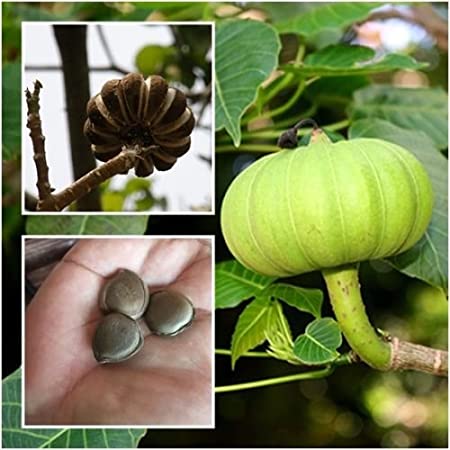
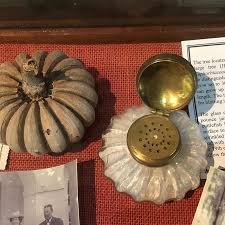
So why is this giant, spiny, exploding, poisonous tree called the sandbox tree anyway? We don’t call rhinoceroses “playground ponies”. It feels like there has been a substantial nomenclatural failure here (at least in terms of the English common name). As it turns out, during the 19th century, the symmetrical green jabillo pods were harvested, dried out, and sawed into little dishes which were filled with pounce. Pounce is powder made of pulverized cuttlefish bone which was sprinkled on crude paper of yesteryear to size it (i.e. to make it possible to write on) or to dry the heavy ink lines from nibs and quills. Wow! It is easy to forget that people of yesteryear were as freakish in repurposing natural materials into household items as we are with our endless disposable plastic goods.

Cherry Tree at Dusk (Wayne Ferrebee, 2020), watercolor and colored pencil on paper
There is a large & venerable Kwanzan Cherry Tree in my backyard in Brooklyn. Each year it blooms for a week (or less) and during that time the garden becomes transcendent in its sublime pink beauty. Nothing symbolizes the sacred renewal of spring more than the cherry blossoms (which I have blogged about often in the past).

Rennie Burning the Broken Fence (Wayne Ferrebee, 2020) Watercolor on paper
Year after year the blossoms come and go so quickly, and, stumbling along behind, I try to capture their evanescent glory with my art. Yet I am never satisfied. This strange pandemic year, I had a bit more time in the garden to draw (after all there were no blossom parties to prepare for) and…for a moment I thought that perhaps I got a bit closer to capturing a smidgen of the tree’s beauty. Yet, now that I have photographed the drawings and watercolor paintings, suddenly they seem alien from the tree’s living glory.

Cherry Blossoms and Holly at Night (Wayne Ferrebee, 2020) Watercolor
So it goes with human endeavor, I suppose. At any rate, here are the drawings. There is a fierce wind howling outside right now (and near freezing temps) so I have a feeling that this is the blossom art portfolio for this year (although maybe I will try some more tulip paintings before those go too). It all goes so fast. it is all so beautiful.

Cherry Blossoms and Tulips (Wayne Ferrebee, 2020) Watercolor on paper
Anyway, here are my cherry blossom paintings this year. Take care of yourself and be safe. There will be another spring next year when we can have the full party with all of the trappings!

Cherry Blossoms on Easter (Wayne Ferrebee, 2020) Watercolor and Colored Pencil on Paper

It is the Yuletide and Ferrebeekeeper is relaxing away from the infernal computer…but it wouldn’t be right to leave the site unattended without a Christmas post, so here is a picture of me cooking an organic chicken so that my friend will come over and eat Mei Fun on Christmas (it turns out that the chicken was merely a free-range, vegetarian chicken which was untreated with steroids and antibiotics (which I don’t think they even give to chickens anyway), so we’ll see if she even participates in this holiday feast). However, of greater interest than this gory (albeit festive) kitchen scene, below please find a picture of my sacred tree of life. Not only is it hung with all manner of different animals from throughout the history of life, there is a very special midwinter animal contemplating its effulgent splendor!

 ferrebeekeeper